Kyphosis in the Pediatric Patient
Good posture and healthy spine development is a universal concern among parents. Children whose curvature exceeds a limited range of variation - curving forward in a “C” shape- will require medical attention and may be diagnosed with kyphosis. Together with scoliosis, another type of curvature, this condition comprises a significant proportion of spinal deformity diagnoses seen by pediatric orthopedists.
Diagnosing Kyphosis
The origin of the Kyphosis can be idiopathic (of unknown origin), congenital (present at birth) or neuromuscular (related to the nerves and muscles). Abnormal development of the spinal column in the womb characterizes congenital kyphosis. The vertebrae may be formed abnormally or may be fused together. Surgical intervention is frequently required in order to prevent progressive deformity as well as to prevent injury to the spinal cord.
Kyphosis is diagnosed in children with a forward curve of greater than 45 degrees.
Children with kyphosis who are able to straighten up to normal posture are considered to have flexible round back deformity. In such cases the pediatric orthopedist may recommend physical therapy to strengthen the back muscles.
In cases where the x-ray shows specific vertebral body changes, the child may be diagnosed with Scheuermann’s kyphosis. This condition usually appears in adolescence. Scheuermann’s kyphosis is marked by the presence of vertebral wedging in three or more vertebrae in a row, which can be seen on a lateral (side-view) x-ray.
Treating Kyphosis
In a growing child, treatment of Scheuermann’s kyphosis with a spine brace may be effective. However, if the deformity continues to progress—reaching 70 degrees or greater—and the child has finished growing, surgical intervention is an option. In such cases, instrumentation is used to bring the spine into alignment, and bone grafts are made to maintain the correction of the spine.
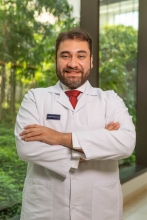
Our medical team
Our multidisciplinary and collaborative environment allows us to address your back condition with personalized recommendations and comprehensive treatment options for acute and chronic cervical, thoracic, and lumbar spine injuries. Correction of angular spinal deformities (scoliosis). Comprehensive treatment of low back pain (operative and non-operative management). Outpatient care and procedures for analgesic control (blocks).
Each member of the spine team focuses on improving your spine health, mobility and overall quality of life.
- Spine trauma
- Degenerative spine pathology
- Oncological pathology of the spine Infections in the spine
- Deformities Spinal metabolic pathology
- Pediatric spine
- Chronic pain treatment
- Minimally invasive surgery
- Spinal endoscopy